This page introduces the Tokyo Metropolitan Government’s efforts to combat volcanic ash.
Driving Experiment for Transport Vehicles under Large-Scale Volcanic Ashfall Conditions
According to the government’s projections (*), a large-scale eruption of Mount Fuji would result in massive ashfall accumulating in the Tokyo metropolitan area. It is estimated that roads would become impassable for two-wheel drive vehicles if ash accumulation exceeds 10 cm in dry conditions and 3 cm in rainfall conditions.
Therefore, during ashfall, the disruption of road functions would limit transportation capacity, potentially making it difficult to supply essential goods for daily life. To address this, in considering measures for transporting goods, we conducted a survey on the driving capacity of transport vehicles, such as large trucks, that are expected to transport goods during ashfall.
(*) “Measures against Wide-Area Ashfall during Large-Scale Eruptions – Impact and Countermeasures of Ashfall in the Tokyo Metropolitan Area – ~Using Mount Fuji as a Model Case~” (Working Group on Wide-Area Ashfall Countermeasures during Large-Scale Eruptions, Disaster Prevention Measures Implementation Committee, Central Disaster Management Council)
Experiment Overview
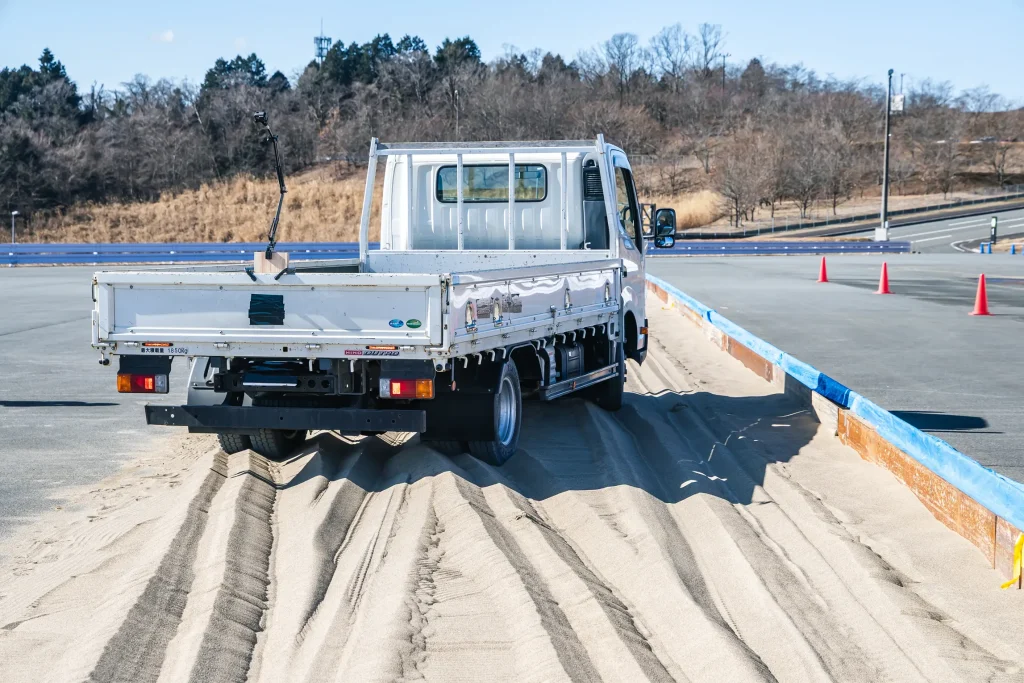
To understand the driving performance and behavior of transport vehicles such as cargo trucks under ashfall conditions, we used simulated ash to measure various parameters related to the feasibility of driving large trucks and other transport vehicles.
We also investigated the impact of loads on driving performance and the effectiveness of using metal chains.
Survey date
February 18th (Thursday) – February 20th (Friday), 2020
Course Overview
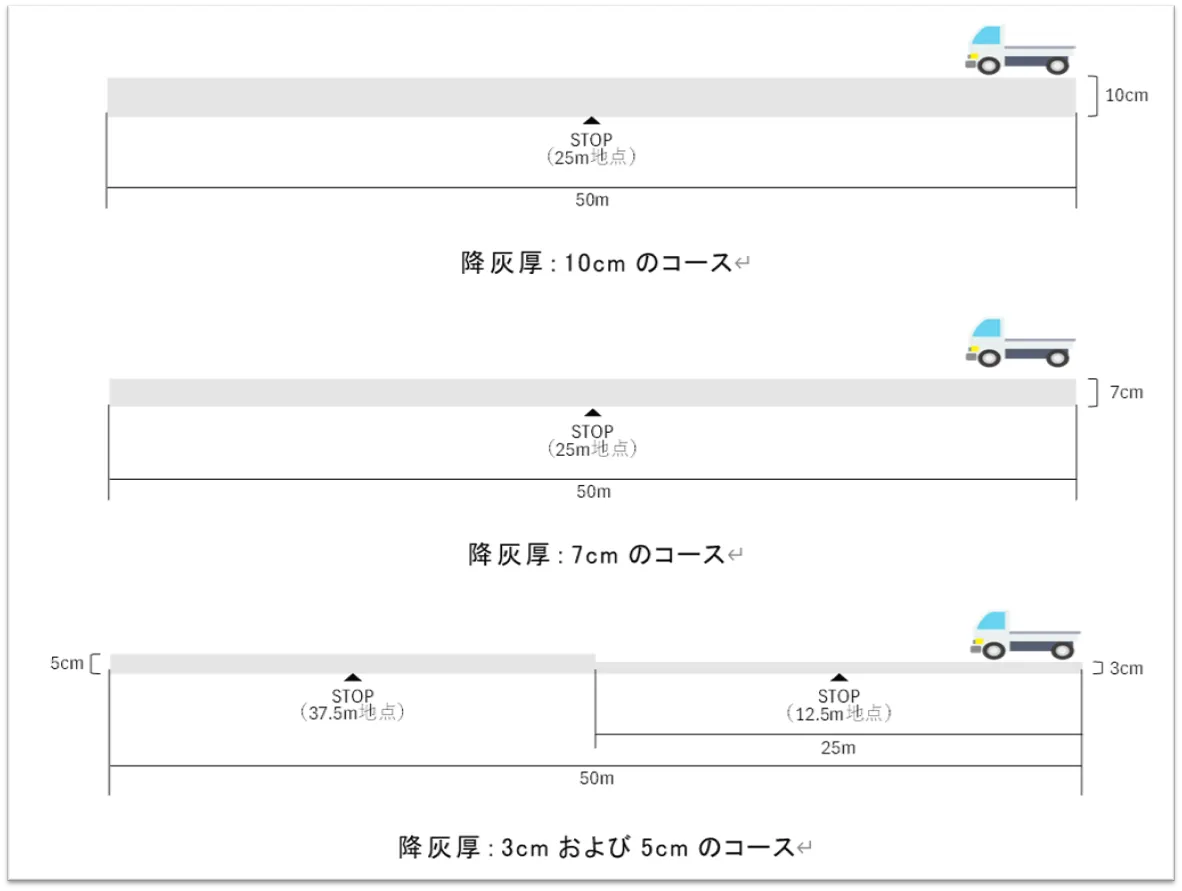
○ Test courses (50m long, 4m wide) were set up to simulate dry and wet conditions. ○ Silica sand No. 4.5 was used as the simulated ash. ○ Ashfall thickness was tested in four stages: 3cm, 5cm, 7cm, and 10cm.
Experimental vehicle
There are five types: 10-ton trucks, 4-ton trucks, 2-ton trucks, cargo vans, and light cargo vans.
Experimental Procedure
– Measure the time taken from the moment the front wheel passes the starting point until the center of the front wheel passes the midpoint or finish line. – To confirm whether restarting is possible after a stop, the vehicle will stop at the midpoint and then restart. – The vehicle will be driven on a 10cm course with a load and with metal chains attached.
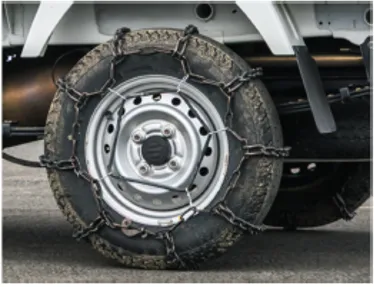
Metal chain
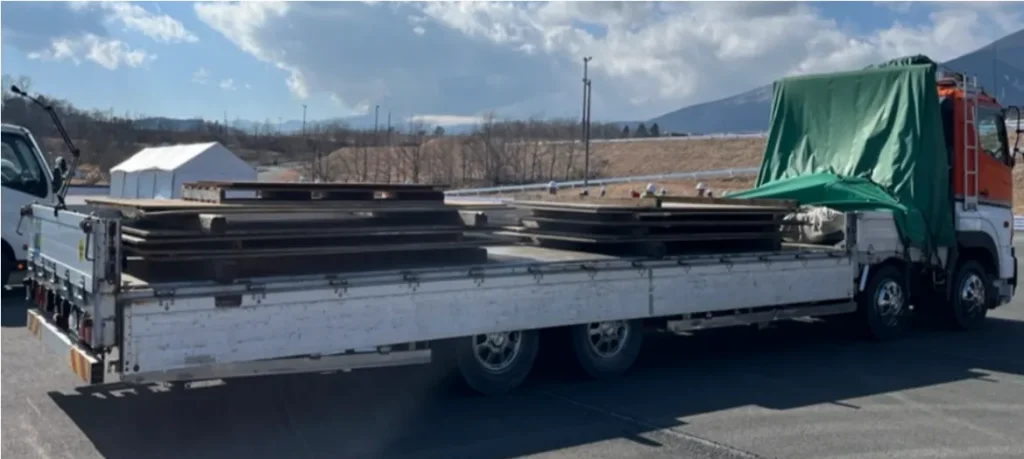
Load steel plates up to the maximum load capacity
Experimental results
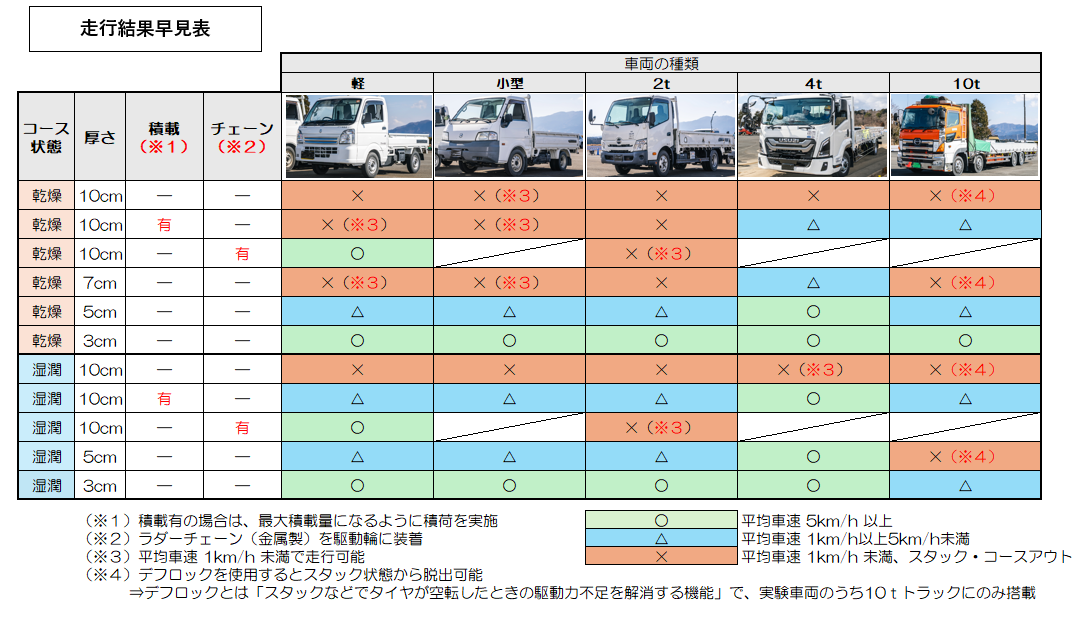
– In dry conditions: Driving is possible up to a thickness of 5 cm. – In wet conditions: Driving is possible up to a thickness of 3 cm; 5 cm is also possible for all trucks except the 10-ton truck. – With load: Driving results are better with a load, regardless of whether the conditions are dry or wet. – With metal chains: Driving results are better with metal chains, regardless of whether the conditions are dry or wet. – Using the differential lock function allows escape from a stuck (immobile) state. *Differential lock is a function that “resolves the lack of driving force when the tires spin due to being stuck, etc.” It is only installed on the 10-ton truck among the experimental vehicles.
Out of course
Stack
Average vehicle speed less than 1 km/h
Average vehicle speed between 1 km/h and less than 5 km/h